Cuisine
Overview
With so many cultures and resources across arra, it's no surprise that the culinary realm is as encompassing as the land itself. For some it's only a matter of everyday food, and for others, an artform.
Ingredients are various, ranging in availability and value. Cutfish for example is a pain to catch, yet its taste is broadly appealing; it fetches for a high price and generally is not easy to come by. In some culinary circles, the chance to work with such an ingredient is a privilege. That doesn't make common ingredients lesser by any means. A basic meal made from plentiful elements is a vital pillar of any society.
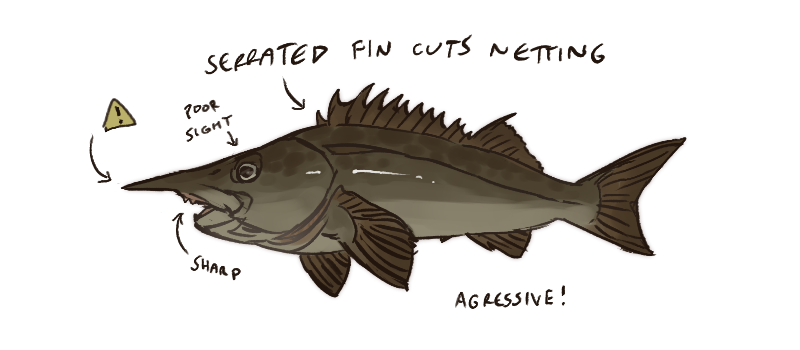
A cutfish, labeled with points of interest. (By Winn)
Methods and Tools
Very early in culinary history, methods such as pickling, curing, drying, and fermentation ruled supreme. Salt was easy to come by, thanks to the ocean. With the advent of fire, several new avenues came to be. Boiling, frying, baking, steaming, smoking, etc.; the sun was no longer the only means of applying heat to food, and warmth became more accessible in colder climes.
The people of Arra have developed many culinary tools over time. Anything from clay pots, woven baskets, steaming baskets, ovens, smokehouses, drying racks, stone mortars, cups, bowls, wooden utensils, saltboxes... Just about everything one could possibly need to make a wide array of dishes.
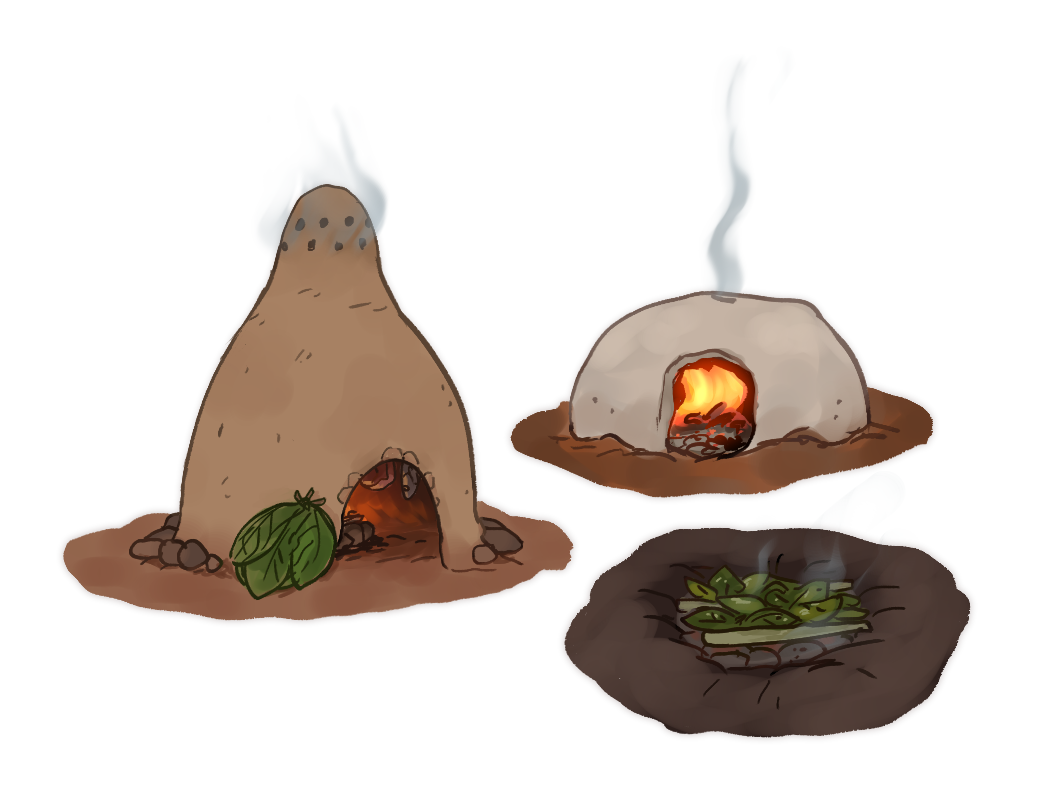
A smokehouse and two sorts of ground ovens. (By Winn)
For those who travel, portable cooking equipment is a must, as is the skill of constructing temporary cooking facilities, such as fire pits, ground ovens, stew basins, and clay chimneys for smoking. In the beginnings of the confluence era, temporary structures would be erected yearly, replaced again and again. Nowadays there are dedicated structures for the arrival of the confluence, though many cooks will still go out of their way to make their own. For some, it's tradition.
Regional and Cultural Contrast
Depending on where you go, you'll be presented with differing options of what to eat. Naturally, distinct regions are ripe with exclusive ingredients, but in an age where trade and delivery are so advanced, this is no longer as definite a rule as it once was. Still, it is both lucrative and fulfilling for clans to celebrate what they have available in their locale, or even cultivate themselves.
There is also the matter of methods. Not all are universally practical; open fires can be dangerous in highly forested regions with a drier atmosphere, which has encouraged many clans to practice cuisine that is not flame-centric. Ground ovens are useful in the fact that they can effectively cook at a smoulder, reducing the amount of open fire that is necessary for the process.
In more humid regions, it can be difficult to find dry enough materials to begin with. Pickling, fermentation, sugaring, and curing are popular in such places, reducing the time it takes for meat and other goods to spoil. In colder areas, for example Icepeaks, freezing food is another way of preservation unique to the area.
Cultural taste is another factor. Most people are bound to gravitate toward meals they find familiar, and if a clan has developed a particular palate, their cuisine will shape to fit it. Through cultural exchange, modified versions of another clan's cuisine may come into existence, tailored to appeal to new tongues. It is through this invention that dishes like honey-roasted quickfin and salted gourd have come to be.
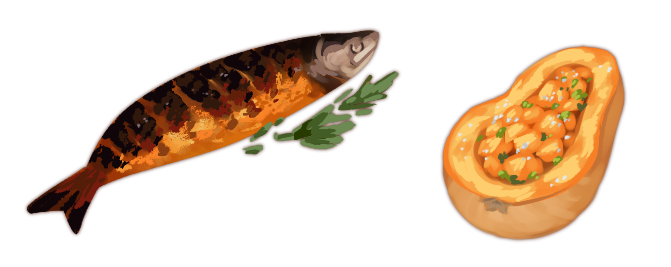
An example of honey-roasted quickfin and salted gourd beside one another. (By Winn)
